
How Gaming Gear is Transforming Technology in Sports and eSports?

eSports

Technology has fundamentally changed the way competition is experienced, both in traditional sports and in the rapidly expanding world of eSports. While athletes have long relied on advanced footwear, performance tracking systems, and specialized training equipment, competitive gamers now depend on a growing ecosystem of high-performance gaming gear to gain an edge. From mechanical keyboards and precision-engineered gaming mice to ultra-fast monitors and low-latency communication devices, gaming gear and equipment has become an essential part of modern digital competition.

The Rise of Performance-Driven Gaming Technology

Competitive gaming has evolved far beyond casual entertainment. Professional eSports tournaments now feature elite players competing for substantial prize pools, sponsorship deals, and international recognition. In such highly competitive environments, even the smallest technical advantage can significantly impact performance.

Gaming gear is specifically engineered to reduce delays and improve responsiveness. Mechanical keyboards, for example, provide faster actuation compared to standard keyboards, allowing players to execute commands more quickly. High-precision gaming mice offer customizable sensitivity settings, helping players react with greater accuracy in fast-paced environments.

This mirrors developments in traditional sports, where athletes increasingly rely on technology-enhanced equipment designed to maximize efficiency and precision. Whether on a football field or inside a competitive gaming arena, performance often depends on how effectively technology supports human skill.

Precision Equipment and Competitive Advantage

In both sports and eSports, precision often separates elite competitors from average performers. For professional gamers, hardware directly influences reaction time, decision-making speed, and execution consistency.

Several core devices define competitive gaming performance:

  • Mechanical keyboards with faster tactile response
  • Gaming mice featuring adjustable DPI sensitivity and precision sensors
  • High-refresh-rate monitors delivering smoother visual feedback
  • Low-latency headsets enabling instant team communication
  • Ergonomic controllers and accessories reducing physical strain during long sessions

For example, a monitor running at 240Hz refresh rate provides significantly smoother motion tracking than a standard display.

In competitive first-person shooters, this visual clarity can improve reaction time by milliseconds, a small difference that often determines victory or defeat.

Traditional athletes rely on equipment optimized for performance, and eSports professionals now operate under the same principle.

How Gaming Gear Improves Physical Performance in eSports?
Although eSports is digital, physical performance still plays a major role in success. Professional players often compete for hours under intense concentration, requiring endurance, coordination, and consistent motor control.

Gaming peripherals are increasingly designed with ergonomic science in mind. Long gaming sessions can lead to wrist strain, muscle fatigue, and repetitive stress injuries if equipment is poorly designed. Modern gaming gear addresses these concerns through improved ergonomics and customizable setups. In fact, there are plenty of benefits that can be enjoyed to investing in modern gaming gear such as:

  • Reduced wrist and finger fatigue
  • Improved posture through adjustable seating and desk accessories
  • Better hand positioning for faster response times
  • Lower long-term injury risk during extended gameplay

This reflects trends seen in traditional sports medicine, where equipment is designed not only for immediate performance but also for long-term physical sustainability. Competitive gaming is increasingly treated with the same level of biomechanical consideration.

The Overlap between Traditional Sports Technology and eSports

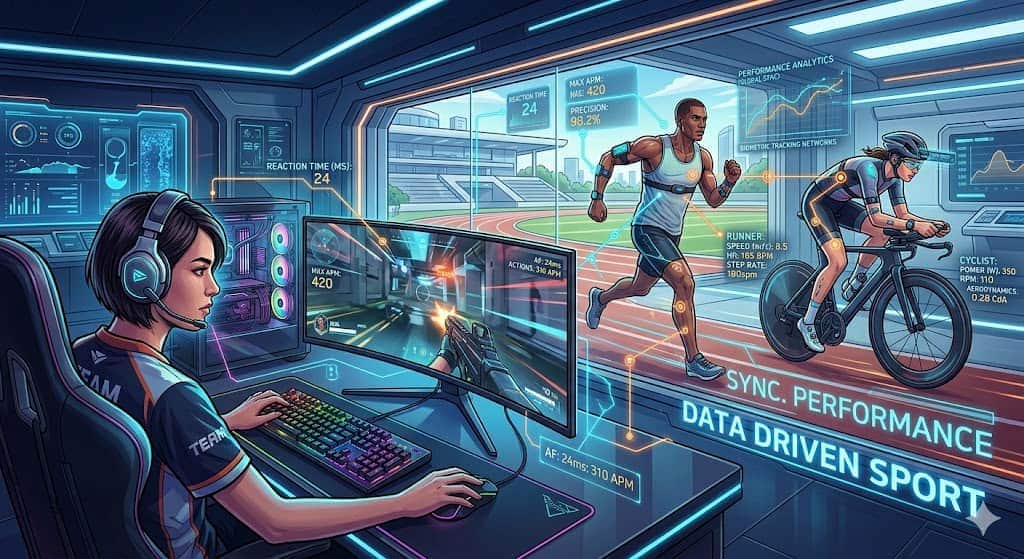
The distinction between sports and eSports continues to narrow as both industries adopt similar technological strategies. Professional athletes use wearable devices, motion-tracking systems, and biometric analytics to improve performance. In eSports, gaming technology serves an equivalent function by optimizing player interaction with digital environments. This is the same reason why many advanced gaming setups are now integrating:

  • Performance monitoring software
  • Real-time latency tracking
  • Custom hardware profiles for different game genres
  • AI-assisted optimization systems for resource management

Interestingly, sports organizations are beginning to study eSports technology for training applications. Virtual simulations and reaction-based gaming tools are increasingly used to improve cognitive speed and hand-eye coordination among athletes.

This crossover demonstrates how gaming technology is influencing broader performance science across multiple competitive disciplines.

The Future of Competitive Performance Technology

As technology advances, gaming gear will continue becoming more sophisticated. Artificial intelligence, adaptive hardware, and biometric feedback systems are expected to redefine how players interact with competitive environments. It is expected that future innovations may include:

  • AI-driven peripherals that adjust sensitivity automatically
  • Eye-tracking systems for faster targeting control
  • Adaptive controllers based on player behavior patterns
  • Wireless technologies with virtually zero latency
  • Haptic feedback systems for deeper sensory immersion

These advancements suggest that future competition will increasingly depend on how well technology amplifies human performance.

In both traditional sports and professional gaming, success is becoming a partnership between talent and equipment.

Growth and Consistent Usage of Modern Gaming Gear to Sports Scene

Gaming gear has become one of the most important technological drivers behind modern competitive performance. In eSports, specialized equipment directly influences speed, precision, communication, and physical endurance, making hardware just as important as player skill.

As traditional sports and digital competition continue to overlap, gaming technology is emerging as a broader performance innovation sector. From mechanical keyboards to ultra-responsive displays, today’s gaming gear reflects a larger trend where precision engineering shapes the future of competition.

The Esports Industry: A Huge Success Story for the Future

eSports, Sports and Technology, Technology

The esports industry has grown at a double-digit annual growth rate over the past few years. There are many benefits of joining this exciting and growing industry, including having a stable job, flexible hours, and the opportunity to meet new people and make friends. If you’re thinking about joining the esports industry as a pro player or streamer, this blog post will give you all the information you need to get started. Keep reading if you want to know more!

What is the Esports Industry?

The esports industry is a business that revolves around people playing and watching video games.

The esports industry is growing quickly and will soon become one of the most watched and profitable sports leagues in the world. The popularity of esports has increased tremendously over the past decade. During the last few years, esports has become an extremely popular sport, and many people enjoy watching it as much as they enjoy football, baseball, or basketball.

How much Money do Pro Players and Streamers Make?

It is difficult to say exactly how much money a person can make as a pro player or streamer, since there are many different factors that affect this. However, on average, pro players and streamers make at least $15 to $20 per hour, or around $30,000 per year.

To make more money as a pro player or streamer, you’ll need to have exceptional skills, be very knowledgeable about the game, and have a large social media following. You also must have a consistent streaming schedule, as well as consistency in the quality of your content.

Tasks and Responsibilities of an Esports Pro Player or Streamer

As an esports pro player or streamer, you’ll be responsible for many different tasks. Check out some of it below:

  • Be a role model – You must be a role model for your fans and followers. You should set a good example for others by being positive, friendly, and helpful. You must also use your skills and fame to make a positive impact on others.
  • Grow your skills in other areas – You must keep improving your skills in areas such as content creation, communication, and personality development. You must also have a strong knowledge of your game’s history. You can search tutorials by other high skilled players like in Call of Antia tier list. Then, you can repeat the process and pass on the knowledge you acquired to others.

The Rise of eSports

eSports

Today, there are more people tuning into online gaming tournaments than the average baseball or football game. In fact, eSports (short for “electronic sports”) have been growing at an astonishing rate over the past decade. In all honesty, it has even surpassed traditional businesses and other online stores such as egirl shop and a lot more.

In this article, we’ll explore what eSports are, how they’re different from traditional video games, and why so many people are tuning into virtual competitions instead of popular sports spectacles

What is eSports?

eSports is short for Electronic Sports. A form of competition where players or teams compete against each other in video games. In eSports, the contestants usually play video games that are either based on real life sports (like soccer) or video games that were specifically designed for eSports competitions. 

Because eSports is a digital sport, it can be watched online and can draw millions of viewers every day. Anyone can make a career out of eSports, but the most obvious way to make money is to win prize money by placing in competitions.

Why is eSports so popular?

Like any sport, the popularity of eSports depends on the people playing it. The more eSports becomes a part of mainstream culture, the more people will be interested in it. There are many reasons why eSports has become so popular and one of them is its accessibility. For one, eSports games are played online, so you don’t need to travel anywhere to compete. 

How eSports is Generating Profits?

As we’ve seen, eSports is a fast-growing industry with a very enthusiastic fan base. If you love playing video games and you enjoy competing, eSports might be the right career path for you. Making a career out of eSports can be challenging and difficult, but it can also be very rewarding. Here is a way to make money in eSports:

  • Compete in eSports competitions – Competing in eSports competitions is the most obvious way to make money in eSports.

If you are a skilled video gamer, you can make a career out of it by competing in eSports competitions.

11 Best Sport and Fitness Mobile Apps

Athletes, Athleticism, eSports, Recreational Sports, Sports and Health, Sports and Technology, Technology

sports-apps

Smartphones can easily replace expensive gyms. Whether you’re running, home training, or calorie counters, we’ve selected the best free fitness app for Android, IOS, and Windows. You can use Cydia Free for iOS for easy access to these apps and fewer restrictions.

Running or Cycling – the Best Fitness App for Endurance Sports:

1. Runtastic

With Runtastic, you can use GPS technology to record different values ​​of sports and fitness activities (distance, duration, speed, calorie consumption, etc.).

2. Endmond

Whether you’re running, cycling, or inline skating, set your own goals and the Endomondo Sport-Fitness-App will inspire you during training. You can also share your activities with your friends and compete with them.

3. ADIDAS miCoach

The miCoach fitness app will be your personal running trainer. With GPS and audio coaching, the app guides you through different training phases while running.

Sports App as a Fitness Trainer:

4. MyFitnessPal

MyFitnessPal is a training app for counting calories. You can easily record all your meals from our huge food database and even record your training sessions.

5. Argus

Argus’ fitness app brings together a step and calorie counter, a GPS activity tracker, a photo nutrition diary, and a sleep tracker. You can also use it to track the amount of water, tea, and coffee you drink.

6. Loox Fitness Planner

The Loox Fitness Planner is suitable for those who train in the gym. The sports app keeps track of your training progress so you can always get new motivation.

Best Training App:

7. Freeletics

The Freeletics fitness app is now mostly cult. Training with a video guide is really rewarding. There are over 700 variations of training, exercises, and runs.

8. 7 minutes workout challenge

The Seventh Fitness Challenge consists of 7 months and 7 minutes of training each day. If you skip training three times a month, your progress will be reset to zero and you will have to start over.

9. Phytoclassy

You will receive the various training described in the video. In addition, you’ll collect points for successful training and unlock new exercises and challenges.

10. Yoga.com

If you like to make it easier, the yoga.com fitness app is perfect! HD quality video guides you through about 300 poses and breathing exercises.

11. Nike + Training Club

Choose from over 100 workouts developed by your trainer and get your friends to support you at the same time. You can then personalize your training and share it with your photos.

12. VeryFitPro

A free pedometer app with other cool features. As soon as you enable Bluetooth on your smartphone, your tracker will be recognized and your data will be synced. You have the option of tracking your diet and calories burned.